How to Advertise on ChatGPT
The way people search for products, services, and information is changing rapidly. Instead of relying only on traditional search engines, users are increasingly asking AI assistants conversational questions and expecting direct recommendations.
This shift has created a new opportunity for businesses that want to understand how to advertise on ChatGPT and increase their visibility across AI-powered search.
However, advertising on ChatGPT is not exactly the same as running a traditional Google Ads or Meta Ads campaign. Businesses need to think about both paid advertising opportunities and the broader question of how their brand, website, products, and content can be discovered and understood by AI systems.
This is where AI search optimization becomes increasingly important.
In this guide, we’ll explain how businesses can approach ChatGPT advertising, improve their AI search visibility, optimize ecommerce product information, and build a digital marketing strategy designed for the changing search landscape.
Can You Advertise Directly on ChatGPT?
One of the most common questions businesses ask is whether they can simply create an advertisement on ChatGPT in the same way they would create a Google Ads campaign.
The answer depends on the advertising products, availability, eligibility, and formats offered by the platform at a particular time.
Because AI platforms continue to evolve, businesses should avoid building their entire strategy around one advertising format.
Instead, it makes sense to build a broader AI visibility strategy.
This can include:
- Optimizing your website for search and AI discovery
- Creating useful and authoritative content
- Improving product information
- Using structured data
- Maintaining accurate product feeds
- Building brand authority
- Improving traditional SEO
- Using PPC advertising where appropriate
- Monitoring how your brand appears in AI-powered search experiences
The goal is to make your business easy to understand, discover, and evaluate.
Why ChatGPT Matters for Businesses
AI assistants can change the way customers research products and services.
For example, instead of searching for several websites individually, a customer might ask:
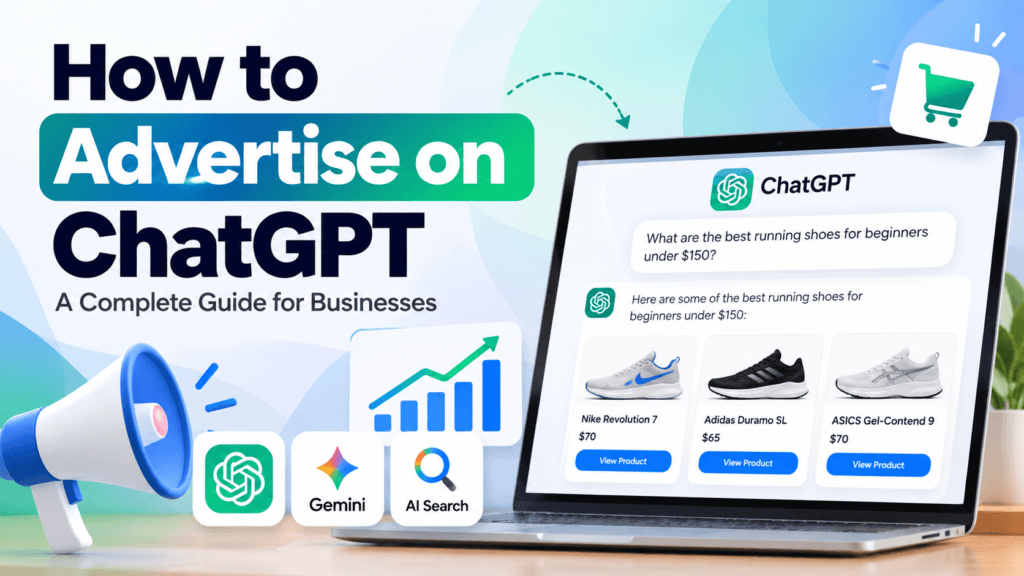
“What are the best running shoes for beginners under $150?”
Or:
“Which Shopify apps can help my store improve product discovery?”
Or:
“Find a digital marketing agency that specializes in AI search optimization.”
These types of conversational searches are different from traditional keyword searches.
The user is expressing an entire intent rather than typing a short keyword.
This means businesses need to provide complete, useful information that clearly explains what they offer and who their products or services are designed for.
What Is AI Search Optimization?
AI search optimization focuses on improving your website, content, products, and online presence so that AI-powered search systems can better understand your business.
Traditional SEO focuses heavily on helping websites appear in search engine results.
AI search optimization takes a broader approach.
It considers how your brand and information may be interpreted across conversational and generative search experiences.
For example, a business should clearly communicate:
- What products or services it provides
- Who those products or services are for
- Where the business operates
- What problems it solves
- What makes its products different
- What features its products offer
- How customers can purchase or contact the business
Businesses looking to build a stronger presence in AI-powered search can learn more about AI Search Optimization and how it can complement traditional SEO.
How to Advertise on ChatGPT Through AI Visibility
If your goal is to understand how to advertise on ChatGPT, it helps to separate the strategy into two areas.
The first is paid advertising.
The second is organic visibility and discoverability.
Even if a business uses paid advertising, having a website with accurate, useful, and well-structured information remains important.
Here are some practical steps businesses can take.
1. Build a Strong Website
Your website is the foundation of your online presence.
Your homepage should immediately explain:
- Who you are
- What you sell
- Who you serve
- What makes your business different
- How customers can take the next step
Your service and product pages should provide detailed information instead of relying on vague marketing statements.
For example, instead of writing:
“We provide the best SEO services.”
A stronger page could explain:
“Our SEO services focus on technical SEO, content optimization, keyword research, internal linking, local SEO, and improving organic search visibility.”
Specific information gives users and search systems more context.
2. Improve Your Traditional SEO
AI search does not mean businesses should stop investing in traditional SEO.
Technical SEO, content quality, internal linking, crawlability, page experience, and structured information remain important parts of a strong digital presence.
Businesses should regularly review:
- Page titles
- Meta descriptions
- Heading structure
- Internal links
- Broken links
- Canonical URLs
- XML sitemaps
- Robots.txt
- Page speed
- Mobile usability
- Structured data
- Indexability
If your business needs help building a stronger organic search foundation, your SEO Services can provide a natural next step for visitors interested in improving their traditional search visibility.
Google provides extensive documentation through Google Search Central, including resources for website owners and SEO professionals.
3. Create Helpful Content
Content can help businesses answer the questions customers are already asking.
Instead of publishing articles purely to target keywords, create content that solves real problems.
For example, an ecommerce company selling furniture could publish:
- How to choose furniture for a small apartment
- How to clean wooden furniture
- Leather vs. fabric sofas
- How to measure a room before buying furniture
- What furniture materials last the longest
A Shopify store could create:
- How to improve Shopify SEO
- How to optimize Shopify product pages
- How to improve product discoverability
- How to prepare Shopify products for AI search
- How AI is changing ecommerce discovery
This type of content provides additional context around your products and expertise.
4. Optimize Product Pages
Product pages are especially important for ecommerce businesses.
Each product page should contain accurate and detailed information.
Consider including:
- Product title
- Detailed description
- Features
- Benefits
- Specifications
- Price
- Availability
- Brand
- SKU
- Product variants
- Images
- Image alt text
- Shipping information
- Return information
- Customer reviews
Avoid using the same generic description across hundreds of products.
Unique and informative product information creates a better experience for customers and gives search systems more context.
Product Feeds and AI Search
For ecommerce businesses, product feeds can help organize important catalog information into structured formats.
A product feed can include information such as:
- Product ID
- Product title
- Product description
- Product URL
- Image URL
- Price
- Currency
- Availability
- Brand
- SKU
- Category
- Variant information
Keeping these details accurate is particularly important for online stores with large product catalogs.
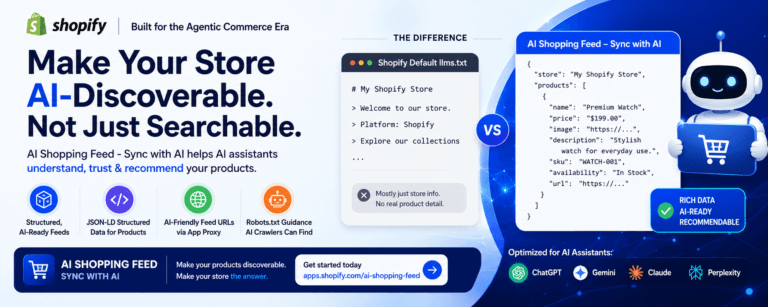
Shopify merchants can use tools such as AI Shopping Feed for Shopify to create AI-ready product feeds and keep catalog information synchronized.
The goal is to make product information cleaner, more structured, and easier to work with across AI-powered discovery experiences.
5. Use Structured Data
Structured data provides search engines with additional information about the content of a webpage.
Depending on the type of page, businesses may use structured data for:
- Products
- Organizations
- Businesses
- Articles
- Events
- Reviews
- FAQs
- Breadcrumbs
Schema.org provides a standardized vocabulary for structured data used across the web.
For ecommerce businesses, product-related structured data can help communicate information such as product names, offers, availability, and other relevant details.
Businesses should implement structured data carefully and make sure the markup accurately represents the visible content on the page.
6. Make Your Website Easy to Crawl
Technical accessibility is another important part of search visibility.
Check whether search engines and other legitimate crawlers can access important pages on your website.
Review:
- Robots.txt
- XML sitemap
- Canonical tags
- Internal links
- Redirects
- 404 errors
- Noindex directives
- JavaScript rendering
- Mobile usability
An important product or service page that cannot be properly accessed or indexed can create unnecessary visibility problems.
Google Search Central provides documentation and tools for understanding how websites are crawled, indexed, and displayed in search.
7. Build Brand Authority
AI visibility is not only about your own website.
Your brand may also appear across other websites, publications, directories, review platforms, social networks, and industry resources.
Businesses can build legitimate authority through:
- Industry publications
- Expert interviews
- Relevant guest articles
- Partnerships
- Industry directories
- Customer reviews
- Business profiles
- Case studies
- Original research
- Digital PR
The goal should be genuine brand recognition.
Avoid creating large numbers of low-quality links simply to manipulate rankings.
Relevant mentions from trustworthy sources can provide more meaningful value than large quantities of irrelevant links.
SEO, PPC, and AI Search Work Together
Businesses don’t necessarily need to choose between SEO, PPC, and AI search optimization.
These channels can support different stages of the customer journey.
SEO
SEO focuses on building long-term organic visibility.
It can help businesses attract customers who are actively searching for information, products, and services.
PPC
PPC can help businesses reach targeted audiences through paid advertising platforms.
It can be particularly useful when businesses want to promote specific services, products, offers, or campaigns.
AI Search Optimization
AI search optimization focuses on making business information easier for AI-powered systems to understand and potentially surface in conversational discovery experiences.
A modern strategy can therefore combine:
SEO + PPC + Content Marketing + AI Search Optimization + Structured Product Data
This approach gives businesses multiple opportunities to reach potential customers.
How Shopify Stores Can Prepare for AI Search
Shopify merchants have a particularly strong reason to pay attention to product data.
An ecommerce store can contain hundreds or thousands of products, variants, prices, images, descriptions, and inventory records.
Start by auditing:
- Product titles
- Product descriptions
- Product images
- Image alt text
- Product categories
- Variants
- Pricing
- Availability
- Brand information
- Product structured data
- Internal links
- Product feeds
Make sure your product information is consistent and accurate.
If your Shopify store has a large catalog, automation can reduce the amount of manual work required to maintain product feeds.
AI Shopping Feed for Shopify is designed to help merchants synchronize Shopify product information into AI-ready feeds and provide guidance around discovery setup.
What Is the Role of llms.txt?
The llms.txt concept has attracted attention as businesses explore ways to provide AI systems with structured information about websites.
However, businesses should not treat llms.txt as a guaranteed ranking or advertising mechanism.
The fundamentals should come first:
- Useful content
- Technical SEO
- Accurate information
- Structured data
- Accessible webpages
- Strong internal linking
- Quality product information
- Strong brand signals
Additional AI-focused files and resources can complement these foundations.
Common Mistakes to Avoid
When learning how to advertise on ChatGPT, businesses should avoid several common mistakes.
Keyword Stuffing
Repeating the same keyword excessively can make content difficult to read.
Use your focus keyword naturally and include related terms where they make sense.
Thin Product Pages
A product page with only a name, price, and one sentence may not provide enough useful information.
Add specifications, benefits, FAQs, images, usage information, and other relevant details.
Outdated Information
Incorrect pricing, unavailable products, or outdated specifications can negatively affect the customer experience.
Keep your catalog synchronized.
Ignoring Technical SEO
A website can look excellent but still have technical issues that affect crawling and indexing.
Regular technical audits are important.
Low-Quality Backlinks
Avoid purchasing large quantities of irrelevant backlinks.
Focus on relevant, legitimate, and useful mentions.
Creating Content Only for AI
Your content should ultimately help people.
Don’t publish low-quality pages simply because you believe AI systems may read them.
How to Measure AI Search Visibility
Measuring AI visibility can be more complicated than measuring traditional SEO.
Businesses can monitor:
- Brand mentions
- Organic traffic
- Referral traffic
- Branded searches
- Product visibility
- Search impressions
- Click-through rates
- Leads
- Sales
- Conversions
- Content performance
As AI search develops, businesses will likely have access to more specialized tools for tracking these interactions.
For now, combining traditional analytics with regular AI visibility checks can provide useful insights.
The Future of Advertising on ChatGPT
AI-powered discovery is still developing, and advertising models may continue to change.
The customer journey could become increasingly conversational.
Instead of searching for ten products individually, a customer might tell an AI assistant what they need, their budget, preferred features, and other requirements.
The AI system can then help narrow down potential choices.
For businesses, this makes accurate product information increasingly important.
Your product data, website content, brand reputation, customer reviews, and overall digital presence can all contribute to how easily your business can be understood online.
Final Thoughts
Understanding how to advertise on ChatGPT requires more than simply looking for a traditional advertising placement.
Businesses should prepare for a broader shift toward AI-powered discovery by improving their websites, content, SEO, product data, and brand visibility.
Start with the fundamentals:
- Build a technically strong website
- Improve your SEO
- Create useful content
- Optimize product pages
- Use structured data
- Maintain accurate product information
- Build legitimate brand authority
- Use PPC where appropriate
- Prepare product feeds for AI discovery
- Monitor your brand’s visibility across AI-powered search
For Shopify merchants, maintaining accurate and structured product information can be particularly valuable.
If you’re looking to improve your visibility across AI-powered search, explore our AI Search Optimization services and learn how your business can prepare for the next generation of search.
Shopify merchants can also explore AI Shopping Feed to simplify the process of preparing product information for AI-powered discovery.
The future of search is becoming increasingly conversational. Businesses that focus on accurate information, useful content, strong SEO, structured data, and a clear digital presence will be better prepared to adapt as the search landscape continues to evolve.
Frequently Asked Questions
Can businesses advertise directly on ChatGPT?
Advertising availability and formats can change as AI platforms evolve. Businesses should check the latest official information while also developing their broader AI search visibility strategy.
How can I get my products discovered by ChatGPT?
Start with accurate product information, strong technical SEO, structured data, useful content, consistent product feeds, and a clear online brand presence.
Is SEO still important for AI search?
Yes. Technical SEO, crawlability, useful content, internal linking, structured information, and website quality remain important foundations for digital discovery.
What is AI Search Optimization?
AI Search Optimization focuses on improving a website, content, product information, and brand presence so AI-powered search systems can better understand the business and its offerings.
Can Shopify stores optimize for AI search?
Yes. Shopify merchants can improve product titles, descriptions, structured data, technical SEO, content, internal linking, and product feeds to support AI-powered product discovery.
Is PPC being replaced by AI search?
AI search does not necessarily replace PPC. SEO, PPC, content marketing, and AI search optimization can work together as part of a broader digital marketing strategy.